How to build a REST API: 7 Proven Steps for Success
Building a REST API is a fundamental skill in modern web development, serving as the critical bridge that allows different software systems to communicate and share information. Think about your favorite mobile app fetching the latest social media feed or weather updates from a server—that’s often a REST API in action.
REST, which stands for Representational State Transfer, isn’t a specific tool or software. Instead, it’s an architectural style, a set of guidelines for designing networked applications. It cleverly uses standard HTTP requests—the same ones your web browser uses to load websites—to access, create, update, and delete data. REST adheres to six key principles that help make APIs reliable and scalable:
- Client-Server Architecture: The client (like your mobile app) and the server (where the data resides) operate independently. This separation allows each to evolve without affecting the other.
- Statelessness: Every request from a client to a server must contain all the information needed for the server to process it. The server doesn’t store any context from previous interactions, which enhances reliability and scalability.
- Cacheability: Server responses can be marked as cacheable or non-cacheable. Clients can store frequently accessed data locally, which reduces server load and speeds up applications.
- Layered System: A client might interact with an intermediary server (like a proxy or load balancer) before reaching the end server. The client doesn’t need to know about these layers; the interaction remains seamless.
- Optional Code-On-Demand: Servers can send executable code to clients if needed, adding an element of flexibility, though this is rarely used.
- Uniform Interface: This principle standardizes how clients and servers interact. It involves identifying resources, manipulating them through representations (like JSON), using self-descriptive messages, and employing hypermedia (links within data) for navigation.
REST APIs are incredibly popular. A 2023 report from Postman, a leading API development platform, revealed that 86% of developers rely on REST as their primary API architecture. Its power stems from these interface constraints, which promote predictability and ease of use.
A well-designed REST API is inherently stateless. This means each request from a client to the server must contain all the necessary information for the server to fulfill it. The server doesn’t retain any “memory” of the client between requests. This approach simplifies server design and significantly improves its ability to handle numerous users concurrently.
REST APIs commonly use JSON (JavaScript Object Notation) for data exchange. JSON is favored because it’s lightweight, easy for both humans and machines to read, and compatible across many programming languages. XML is also supported, though less common nowadays.
REST APIs leverage standard HTTP methods to perform actions on resources. Here’s a quick overview:
- GET: Retrieves data (e.g., “GET all users”).
- POST: Creates new data (e.g., “POST a new user account”).
- PUT: Completely updates existing data (e.g., “PUT this entirely new information for this user”).
- PATCH: Partially updates existing data (e.g., “PATCH only the email address for this user”).
- DELETE: Removes data (e.g., “DELETE this user account”).
As APIs evolve, managing different versions is crucial to ensure older applications continue to function while newer ones adopt the latest features. This is known as versioning. Common strategies include adding the version number to the URL (e.g., /v1/users), including it in request headers, or using a query parameter. This practice ensures that updates don’t break existing systems, maintaining user trust.
Building a REST API by Language & Framework
The programming language and framework you choose significantly impact how you build a REST API. Each ecosystem offers unique tools, strengths, and community support. It’s akin to selecting the right vehicle for a particular journey.

How to Build a REST API with Node.js
Building a REST API with Node.js means using JavaScript for both the browser and the server. Node.js is a JavaScript runtime environment, allowing you to execute JavaScript code outside a web browser. It’s often paired with frameworks like Express.js, a minimalist and flexible web application framework. This combination is excellent for creating fast, scalable server-side applications that efficiently handle HTTP requests and responses.
Express.js stands out as the most popular Node.js framework for API development. It provides robust middleware support, powerful routing capabilities, and simplified HTTP utility methods. A basic Node.js REST API setup typically involves installing Node.js, initializing a project with npm, installing Express.js, and creating server files. These files will import dependencies, initialize the Express app, define middleware like body-parser or cors, create route handlers, connect to a database like MongoDB or PostgreSQL, and start the server. Node.js with Express is a go-to for rapid development, especially for applications requiring efficient handling of numerous simultaneous connections, like chat apps or real-time dashboards.

How to Build a REST API with Python
Python, known for its readability and versatility, offers several powerful frameworks for building REST APIs, making it a developer favorite. These frameworks enable the creation of web services that expose various endpoints for data manipulation. Popular options include Flask, a lightweight micro-framework excellent for simpler APIs; Django REST Framework (DRF), a “batteries-included” solution for more complex APIs; and FastAPI, a modern, high-performance framework that automatically generates interactive API documentation.
The typical development workflow involves installing the chosen framework, defining data models, creating serializers to convert data models into formats like JSON, implementing view functions to handle requests, configuring URL routing, and running a development server for testing. According to JetBrains’ Python Developer Survey 2023, Flask (47%) and Django (42%) remain widely used, with FastAPI rapidly climbing to 24% adoption.

How to Build a REST API in Java
For building robust, scalable, and enterprise-grade web services, Java offers mature and powerful frameworks. Spring Boot is the leading Java framework for REST API development. It simplifies Java’s setup process with features like auto-configuration, embedded servers, and dependency injection. It builds upon Spring MVC to create sophisticated RESTful web services. An alternative is JAX-RS (Jakarta RESTful Web Services), the official Java EE standard, with Jersey as its most prominent implementation.
A basic Spring Boot REST API relies on Java annotations like @RestController, @RequestMapping, and @PostMapping to map URLs and HTTP methods to Java methods. Core business logic is typically separated using @Service and @Repository annotations. Java REST APIs commonly use the Jackson library for JSON conversion, Hibernate/JPA for Object-Relational Mapping (ORM), and Maven or Gradle for dependency management. Java’s strong typing and compile-time error checking contribute to its reputation for building highly reliable applications.

How Can You Build a REST API with Authentication?
Authentication is critical for securing any REST API, acting as the gatekeeper that ensures only verified users or applications can access protected information. It confirms a user’s identity before granting access. _Without proper authentication, your API remains vulnerable to unauthorized access and data breaches._
Several common methods are used for REST API authentication, including simple API Keys, the OAuth 2.0 authorization framework, and JSON Web Tokens (JWTs). JWTs are widely adopted for modern REST API authentication because they are self-contained and cryptographically signed. This enables stateless authentication, where the server doesn’t need to track user login status after the token is issued, reducing server workload and improving scalability.
Secure REST API authentication requires several critical best practices:
- Always use HTTPS/TLS encryption for all client-server communication.
- Implement token expiration and refresh mechanisms to limit the window for attackers.
- Securely store tokens on the client-side, such as in secure HTTP-only cookies.
- Protect against common attacks like CSRF (Cross-Site Request Forgery) and XSS (Cross-Site Scripting).
- Use strong password hashing algorithms like bcrypt or Argon2.
- Implement rate limiting to restrict requests and prevent brute-force attacks.
The OWASP (Open Web Security Project) 2023 API Security Top 10 identifies “Broken Authentication” (API2:2023) as the second-most critical API security risk, emphasizing the importance of robust authentication. Beyond authentication, authorization patterns like Role-Based Access Control (RBAC) are often implemented to control what an authenticated user is allowed to do.

REST API Design & Best Practices
Crafting an effective REST API involves designing it to be intuitive, consistent, maintainable, and secure. Good design ensures other developers can easily understand and use your API, boosting adoption and success.

REST API Endpoints Design
REST API endpoint design focuses on structuring URLs, choosing appropriate HTTP methods, and representing data clearly. The goal is to create an intuitive API interface where endpoints are predictable and easy to understand. You should use nouns, not verbs, for resources (e.g., /users instead of /getAllUsers) and use plural forms for collections. A hierarchical structure shows relationships naturally, such as GET /users/{id}/orders to get all orders for a specific user.
“The key to excellent API design is consistency and predictability. Developers should be able to guess endpoint structures based on patterns, reducing documentation dependency and cognitive load.” – Kin Lane, API Evangelist
Proper HTTP status codes are crucial for clear communication. They inform the client about the request outcome without requiring them to parse custom error messages.
200 OK: Successful request.201 Created: A new resource was successfully created.204 No Content: Successful request with no content to return (e.g., after a DELETE).400 Bad Request: The client sent an invalid request.401 Unauthorized: The client needs to authenticate.403 Forbidden: The client is authenticated but lacks permission.404 Not Found: The requested resource does not exist.500 Internal Server Error: An error occurred on the server.
Ideally, mature API endpoint design incorporates HATEOAS (Hypermedia as the Engine of Application State) principles, where API responses include links to related resources, enabling clients to discover available actions and navigate the API dynamically.

REST API Best Practices
Adhering to REST API best practices is paramount for creating APIs that are secure, performant, scalable, and maintainable. These practices are the foundation of a high-quality API.
First, security is non-negotiable. _You must always use HTTPS/TLS encryption to protect data in transit from eavesdropping and man-in-the-middle attacks._ Implement robust authentication and authorization, validate all inputs to prevent injection attacks, and use rate limiting to protect against abuse.
Second, optimize for performance. Implement caching using HTTP headers, use compression like gzip to reduce data size, and implement pagination for large datasets to avoid sending massive data chunks. For long-running tasks, consider asynchronous processing to improve responsiveness.
Third, focus on documentation. Comprehensive and clear API documentation is vital, as it serves as the primary instruction manual for developers using your API. Use specifications like OpenAPI/Swagger to generate interactive documentation and client SDKs automatically. A 2023 SmartBear report found that 60% of organizations cite poor API documentation as a primary barrier to adoption.
“The most successful APIs treat documentation as a first-class citizen, not an afterthought. Clear, comprehensive documentation with working examples reduces support burden and accelerates developer adoption.” – Mike Amundsen, API Architect
Finally, establish clear error handling, versioning, testing, and monitoring strategies. Use consistent error formats, choose a versioning strategy (like /v1/users), implement a full suite of tests (unit, integration, load), and monitor key metrics like response times and error rates to ensure reliability.

REST API Testing & Alternatives
Building a REST API is only part of the process; ensuring its quality, reliability, and security is equally crucial. This is where thorough testing comes in. Additionally, understanding alternative architectural styles, like GraphQL, is important for choosing the most suitable approach for your project.

REST API Testing Tools
REST API testing tools are software designed to validate an API’s functionality, performance, security, and reliability. Postman is the most widely used platform for the API lifecycle, utilized by the vast majority of developers for API testing. It allows users to build requests, write automated tests, manage environments, and generate documentation. Other valuable tools include Insomnia, a lightweight API client; SoapUI, a comprehensive testing suite; and cURL, a versatile command-line tool.
For automation, developers often use libraries like REST Assured for Java or Pytest with requests for Python. Automated testing frameworks are essential for integrating API testing into CI/CD (Continuous Integration/Continuous Delivery) pipelines. Popular options include Newman (Postman’s command-line runner) and high-performance load testing tools like JMeter, Gatling, and K6.
API testing typically encompasses several types:
- Functional testing: Validates that each API endpoint behaves as expected.
- Integration testing: Checks the correct interaction between API components and external systems.
- Performance testing: Measures API speed and responsiveness under various loads.
- Security testing: Identifies vulnerabilities and guards against common attacks.
- Contract testing: Ensures the API’s behavior aligns with its agreed-upon specification.
A multi-layered testing approach, combining unit tests, integration tests, and consumer-driven contract tests, is crucial for preventing breaking changes and ensuring quality.

Which is Better: REST API vs GraphQL?
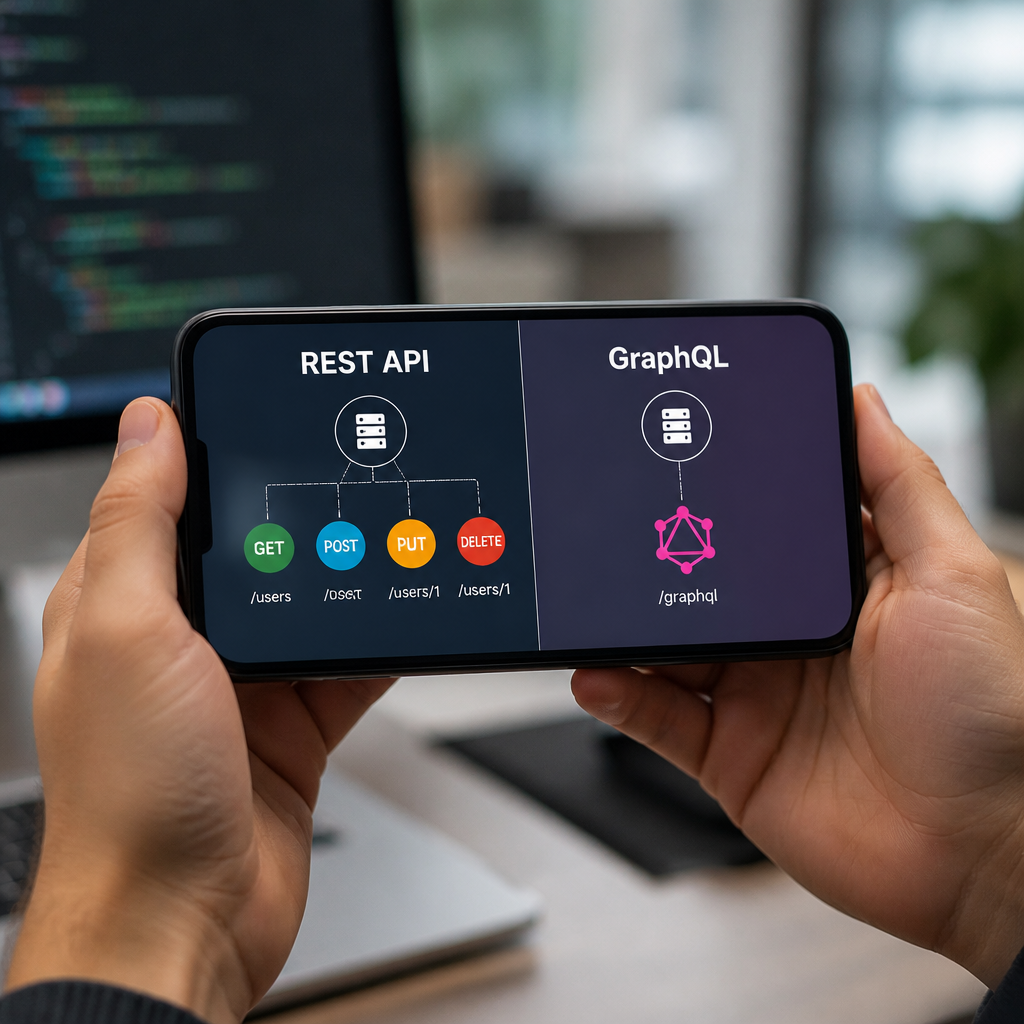
When designing an API, developers often compare REST and GraphQL. Both are effective but offer different client-server interaction models. REST uses multiple endpoints, each returning a fixed data structure, while GraphQL uses a single endpoint where clients send a query specifying exactly the data they need.
| Feature | REST API | GraphQL |
|---|---|---|
| Endpoint Structure |
Multiple endpoints (e.g., /users, /posts)
|
Single endpoint (e.g., /graphql)
|
| Data Fetching | Fixed data structure per endpoint | Client specifies required data in a query |
| Network Requests | Can require multiple requests (under-fetching) | Fetches all required data in a single request |
| Data Payload | Can return excess data (over-fetching) | Returns only the data requested by the client |
| Caching | Natively leverages HTTP caching mechanisms | Caching is more complex and typically client-side |
| Schema/Typing | No mandatory schema; relies on documentation | Strongly-typed schema defines the API contract |
GraphQL’s primary advantage is allowing clients to request precisely the fields they require in a single query, eliminating over-fetching and under-fetching. This is especially beneficial for mobile applications with bandwidth constraints. However, REST is often simpler to implement for basic CRUD operations and excels with mature HTTP caching mechanisms. _While powerful, GraphQL requires careful query complexity analysis to prevent resource-intensive or malicious queries from overwhelming the server._
REST remains the dominant architecture, but GraphQL shows significant growth, with many teams using both to leverage each’s strengths. REST is often preferred for public APIs and simple services where caching is key, while GraphQL excels for complex applications with rapidly evolving client-side data requirements.
In conclusion, building a trustworthy and in-depth REST API involves understanding its core principles, choosing the right tools, implementing robust security, designing intuitive endpoints, and adhering to best practices. Discover how to create effective and reliable APIs by carefully considering these factors and prioritizing quality to foster trust and enable seamless digital experiences.
—
FAQ
Q1. What are the core principles of a REST API?
A1. The core principles of a REST API include a client-server architecture, statelessness (each request contains all necessary information without server memory of past interactions), cacheability, a layered system, optional code-on-demand, and a uniform interface that simplifies communication.
Q2. Which programming languages and frameworks are commonly used to build REST APIs?
A2. Popular choices include Node.js with Express.js, Python with Flask, Django REST Framework, or FastAPI, and Java with Spring Boot or JAX-RS. Each offers distinct advantages catering to different project scales and developer preferences.
Q3. What are some essential security practices for REST API authentication?
A3. Essential security practices include always using HTTPS/TLS encryption for all communications, implementing robust authentication methods like JWT or OAuth 2.0, securely hashing passwords with algorithms like bcrypt, validating all inputs to prevent attacks, implementing rate limiting to prevent abuse, and protecting against common web vulnerabilities like CSRF and XSS.
Q4. How should REST API endpoints be designed for clarity and consistency?
A4. Endpoints should use nouns (plural for collections), a hierarchical structure, lowercase letters, and hyphens (kebab-case) for readability. HTTP methods should map directly to CRUD operations (Create, Read, Update, Delete), and appropriate HTTP status codes should be used for responses. Query parameters can be utilized for filtering, sorting, and pagination of data.
Q5. What are the main differences between REST APIs and GraphQL?
A5. REST APIs typically use multiple endpoints, each returning a fixed data structure, and rely heavily on HTTP caching. GraphQL, in contrast, uses a single endpoint, allowing clients to send precise queries to request only the specific data fields they need. This helps avoid over-fetching or under-fetching data, giving clients more control, while REST is generally simpler for basic CRUD operations and excels with HTTP-native caching.

Hi, I’m Anna Smith, the founder of API Dev Note.
I’m an API specialist with experience working with APIs, integrations, and web development. Through hands-on projects, I’ve learned that understanding how APIs work in real-world environments is just as important as reading the documentation.