What is Headless API: 6 Powerful Benefits Explained
In the past, creating new digital experiences often felt like navigating a maze blindfolded. Each new platform—a website, a mobile app, or a smart display—meant starting from scratch or wrestling with an inflexible, all-in-one system. Creative ideas were frequently stifled by technology. The concept of a “Headless API” emerged as a breakthrough, providing a map and a flashlight for that digital maze. In today’s interconnected world, where seamless experiences across phones, watches, and smart speakers are expected, the old ways no longer suffice. Discover how a Headless API is crucial for anyone building digital products that need to keep pace with rapid technological change. It is like taking apart a toy to use its best parts for something even better, free from the original toy’s limitations.
Understanding Headless API
The way we interact with digital content is constantly changing. While websites were once dominant, now apps, smart devices, and voice assistants are common. This rapid evolution makes traditional “all-in-one” systems, where the frontend (the look and feel) is tightly coupled with the backend (the brains and data), feel slow and restrictive. These older, “monolithic” systems made launching new features a significant challenge. This is where Headless API architecture offers a smarter solution. It promotes more flexible and modular digital platforms, giving developers the freedom to build adaptable applications that can reach anyone, anywhere, on any device.

What is Headless API?
A “headless API” functions like a robot with a brain and a body, but no head. Its brain holds information and performs tasks, and its body can move. It is a type of “Application Programming Interface” (API) that creates a clear separation between the “brain” (the backend) and the “head” (the frontend, or what the user sees). The backend contains all the essential components, like website content, business logic, and data storage. The frontend is what users interact with—the website layout, app buttons, or smart speaker voice. The “headless” aspect means the visual part, or “head,” is detached from the core system, or “body.”
This separation is powerful because the backend provides raw data and services, much like a central pantry supplying ingredients. Different “heads”—websites, mobile apps, or digital displays—can then use API calls to access these ingredients and create their own user experiences. They are not tied to a single, predefined recipe. This approach is often called “omnichannel content delivery,” meaning content can be delivered to all channels from one central location, which eliminates the headache of managing content separately for each platform.
The core idea is to allow different devices and platforms to communicate with the same backend. Instead of building separate backends for your website, mobile app, and smart devices, a single headless backend can serve them all. This is achieved using standard communication methods, often through “RESTful APIs” or “GraphQL.” These act as universal translators that enable any frontend to request data from the backend and understand its responses. This setup typically includes three main components: the “data layer” (databases), the “business logic layer” (the API server), and multiple “presentation layers” (the various frontends).
When frontend and backend teams can work independently, development moves much faster. This speed is invaluable today, where the ability to quickly launch new features and make changes is critical for business success.
Jason Miller, a principal analyst at Forrester Research focusing on digital experiences, stated, “Headless architecture represents a fundamental shift in how we build digital experiences. By decoupling the frontend from the backend, organizations gain the flexibility to innovate on customer experience without being constrained by backend limitations.”

Headless API architecture
Headless API architecture describes a software system where the backend offers all its functions and data purely through APIs, without dictating how that information is presented. This design gives frontend applications complete freedom to be built using any technology that best suits their needs. These frontends connect to the backend’s services using standardized API “contracts,” which define how to request and receive information. This modularity allows different system components to evolve independently, much like Lego bricks that can be swapped out without affecting the entire structure.
Real-world implementations often involve several key components. An “API gateway” typically serves as the initial point of contact for all API requests, acting as a traffic director. The “business logic layer,” which may consist of many small, independent services called “microservices,” handles requests and communicates with the “data persistence layer” (databases). Clear API documentation, such as “OpenAPI,” is crucial as it details how to use the APIs, helping frontend developers connect without confusion.
Modern headless architectures are highly adaptable. While “RESTful APIs” remain common, “GraphQL” is gaining popularity because it allows clients to request precisely the data they need, improving speed and efficiency. Security is also paramount, with systems employing industry-standard protocols like “OAuth 2.0” for authentication and “JSON Web Tokens (JWT)” for secure sessions.
Scalability, the ability to handle increased user loads, is another significant advantage. It allows for independent scaling of API servers and frontend applications. For example, if a website experiences a surge in traffic, frontend servers can be scaled up without affecting the backend. “Content Delivery Networks (CDNs)” also play a vital role by caching API responses closer to users, which can substantially reduce server load and improve speed. The backend serves as the single source of truth for all information, ensuring consistency across all channels.

Headless API vs REST API
The terms “Headless API” and “REST API” are often confused, but they represent different concepts. Think of “Headless API” as describing a type of building (an architectural approach), while “REST API” describes a specific way to build roads to that building (a style of API design). They are not mutually exclusive; in fact, a headless system very commonly uses REST APIs for communication.
A headless API is an architectural pattern focused on completely separating the “head” (user interface) from the “body” (backend). Its purpose is to serve content via APIs to any number of independent frontends. A REST API (Representational State Transfer API) is a specific architectural style for designing how applications communicate, using standard HTTP methods and URLs to identify resources.
| Feature | Headless API | REST API |
|---|---|---|
| Concept | An architectural pattern for decoupling frontend and backend. | An architectural style for designing networked applications. |
| Scope | Describes the overall application structure. | Defines the rules and constraints for API communication. |
| Primary Goal | To achieve technology flexibility and omnichannel content delivery. | To create standardized, scalable, and stateless web services. |
| Technology | Can use REST, GraphQL, or other protocols for communication. | Is a specific protocol/style itself used for communication. |
The primary difference lies in their scope: A REST API defines the technical specifications for API communication, while a Headless API describes the broader architectural strategy of an application. As explained by web architecture expert Mark Nottingham, REST is about how you structure your API calls, while headless is about architectural freedom. You can have a RESTful headless API or a GraphQL headless API. _For an architecture to be truly “headless,” it must achieve complete separation._ This means the backend has no knowledge of, nor dependence on, the frontend’s appearance or functionality.

Headless API Advantages and Applications
Adopting a headless API architecture is a strategic business decision for companies aiming to thrive in a multi-device landscape. The advantages stemming from frontend and backend separation are substantial, impacting development speed, operational efficiency, and customer satisfaction. This modular approach enables businesses to become more agile, innovative, and scalable, allowing them to adapt quickly to market demands. This section will explore the specific benefits of headless APIs and showcase real-world applications where this architecture excels.
What are the benefits of a Headless API?
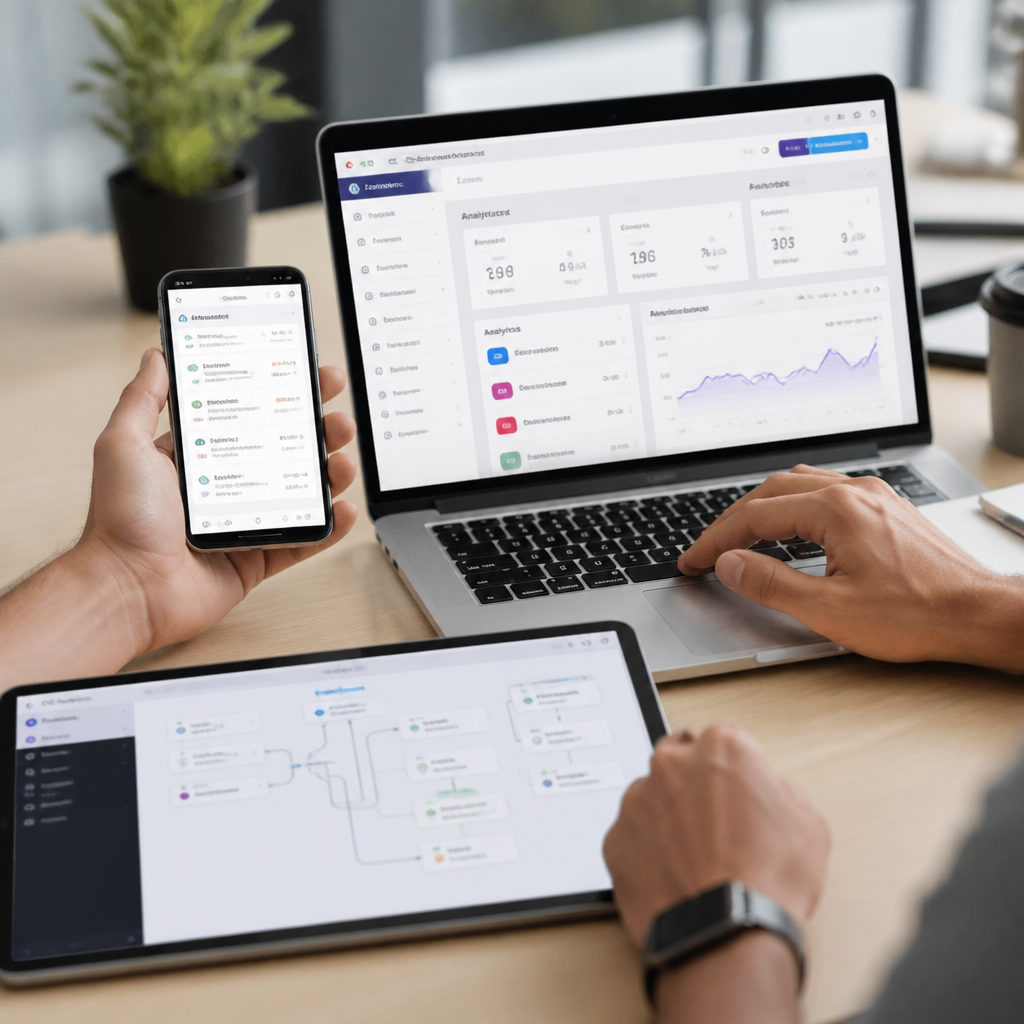
The benefits of a Headless API arise directly from the strategic separation of a system’s frontend and backend. By maintaining separation, each system component can be enhanced and updated independently, fostering a more efficient and adaptable digital ecosystem. These advantages lead to more adaptable development processes, faster feature releases, and an improved developer experience.
- Omnichannel Delivery: Headless APIs enable seamless content distribution across numerous channels—websites, mobile apps, IoT devices, and voice assistants—all managed from a single backend. This ensures consistency and efficiency wherever customers interact with the brand.
- Technology Flexibility: Development teams can select the most suitable frontend tools for a specific channel without being constrained by the backend’s technology. This freedom allows for the easy adoption of newer technologies as they emerge.
- Enhanced Scalability: Frontend and backend resources can be scaled independently, optimizing resource utilization and cost. During high-traffic periods, frontend servers can be scaled up to manage visitors without impacting backend stability.
- Maintenance Efficiency: The separation of responsibilities allows specialized teams to focus exclusively on their domains—frontend developers on user experience, and backend developers on logic and data. This streamlines workflows and quickens bug resolution.
- Future-Proofing: By decoupling the frontend from the backend, businesses protect their digital investments from becoming obsolete. New frontend technologies can be integrated or replaced without disrupting core backend services.
- Performance Optimization: Headless architectures enable advanced techniques like edge computing and CDN integration. By delivering data closer to the end-user, these technologies significantly accelerate content delivery and improve user experience.

Headless API use cases
The use cases for Headless API are remarkably diverse and span numerous industries. The inherent flexibility and scalability of headless design make it ideal for complex digital environments requiring content delivery across multiple channels.
One of the most prevalent applications is in e-commerce platforms. Leading retailers leverage headless APIs to create consistent and personalized shopping experiences across websites, mobile apps, and in-store kiosks. In content publishing, media organizations use “headless CMS” to distribute content simultaneously to their websites, apps, and smart TVs, dramatically reducing publishing time. The centralized content repository ensures consistency across all channels, while each platform can present the content optimally for its users.
Large corporations with multi-brand platforms also benefit significantly. They can use a single backend for core functions like product management and payment processing while each brand maintains its unique frontend experience. For example, a project for a major electronics retailer focused on launching new regional brand websites found that a headless backend allowed them to access the same product database and launch new local frontends in weeks rather than months. This approach unlocked a new capability, saving costs and simplifying management.
Progressive Web Apps (PWAs), which blend the strengths of websites and native apps, are another excellent application. Headless APIs provide the essential data and services to power these rich, interactive web experiences, enabling offline functionality and fast, reliable performance. Internationalization—making content accessible in various languages and regions—is also considerably simplified.

Headless API for e-commerce
Headless API for e-commerce revolutionizes online store development by completely separating the backend—product catalogs, inventory, and order processing—from the customer-facing frontend. All backend functions are exposed through APIs, which can then power a wide array of sales channels, including websites, mobile apps, social media shopping, and voice commerce. This separation provides businesses with exceptional flexibility and control over the customer shopping journey.
Key components of a headless e-commerce system include APIs for managing product information, shopping cart actions, the checkout process, order management, and customer accounts. This granular API access empowers businesses to craft highly customized experiences for each channel. The headless e-commerce market is projected to expand from $1.6 billion in 2023 to $3.9 billion by 2028, according to MarketsandMarkets Research, driven by the increasing demand for seamless omnichannel experiences.
One of the most significant advantages is performance improvement. E-commerce sites built with headless architecture often report page load times that are 40-60% faster than those on legacy platforms. This speed enhancement directly leads to an increase in sales conversions. According to David Schneider, CTO at BigCommerce, headless architecture solves the critical problem of needing to innovate on customer experience without disrupting core business operations. This separation of concerns is why major retailers are migrating to headless. Retailers can operate various digital storefronts—such as a B2C website and a B2B portal—all powered by a single headless backend, ensuring data consistency and efficiency.

Headless API integration
Headless API integration is the process of connecting separate frontend applications with backend services using API “endpoints.” This stage involves establishing secure authentication, defining efficient API usage patterns, ensuring data synchronization, implementing error handling, and integrating with other services. Common integration methods include direct API calls, using an “API gateway” to aggregate calls, or the “Backend-for-Frontend (BFF) pattern,” which creates a custom API layer for each frontend type.
Authentication methods are essential for security. “OAuth 2.0” is widely adopted for user logins, “JSON Web Tokens (JWT)” are used for secure sessions, and “API keys” are employed for service-to-service communication. _Configuring Cross-Origin Resource Sharing (CORS) correctly can be a challenging initial hurdle, but it is non-negotiable for security._
Data synchronization strategies are vital for consistency. “Real-time integration” can be achieved with “WebSockets” for live updates, while “batch integration” uses scheduled calls for less time-sensitive data. Large-scale systems often require “API orchestration layers” to manage the intricate network of API calls to various internal microservices and external third-party services.
Dr. Michael Hausenblas, an expert in distributed systems at Amazon Web Services, emphasizes resilience: “Successful headless integration isn’t just about making API calls—it’s about building resilient systems. You need to handle network failures, API versioning, rate limits, and data consistency across distributed systems. The integration layer is where many headless projects fail because teams underestimate this complexity.”
Techniques like API response caching, request batching, and lazy loading optimize performance. A well-defined “versioning strategy” is also crucial for managing API evolution over time, ensuring that older frontend applications remain compatible when backend APIs are updated.


Hi, I’m Anna Smith, the founder of API Dev Note.
I’m an API specialist with experience working with APIs, integrations, and web development. Through hands-on projects, I’ve learned that understanding how APIs work in real-world environments is just as important as reading the documentation.